
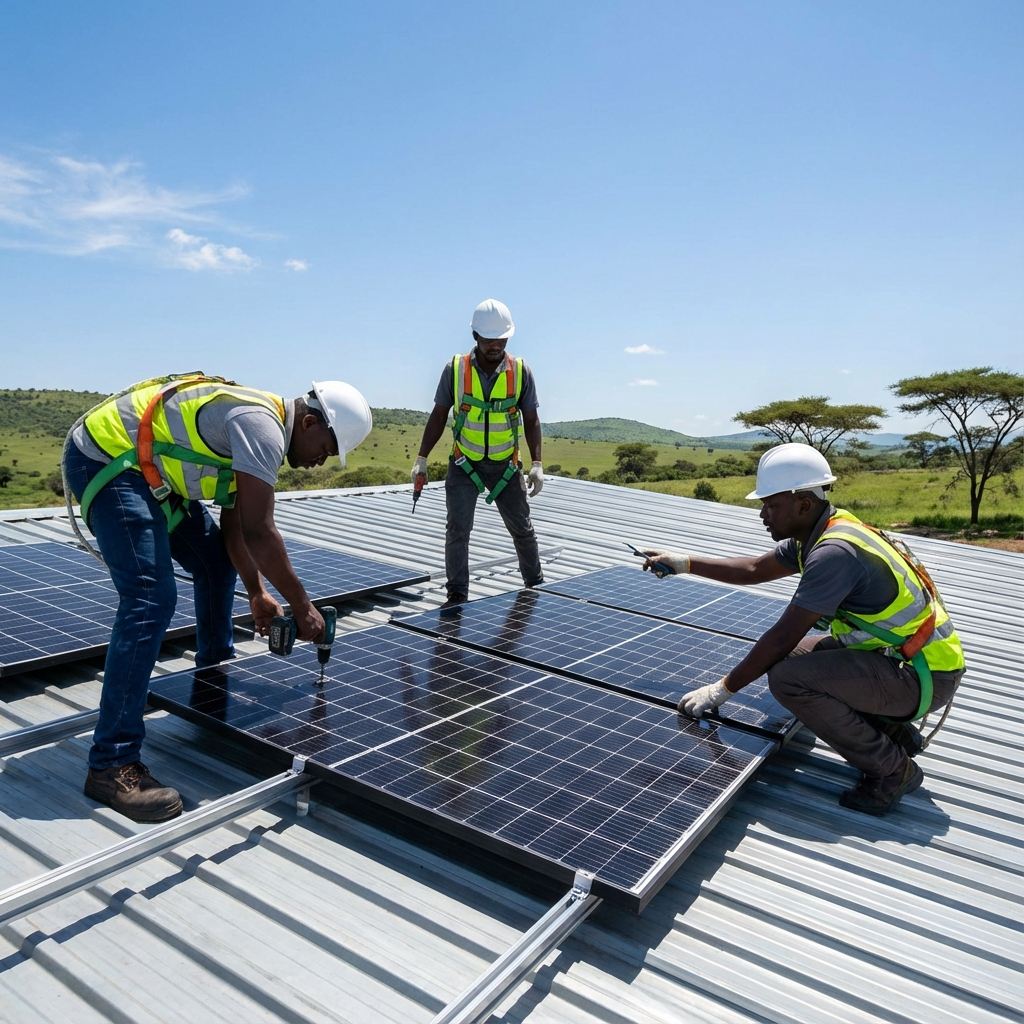
Commercial solar installation in Kenya
Haq Power designs and installs solar systems for shops, offices, farms and industrial sites. Three-phase hybrid and grid-tie systems lower daytime electricity costs and protect operations from outages.
Solar built around how your business runs
Most businesses use the most power while the sun is up, which makes solar a natural fit. We design each system from your load profile and site.
- Three-phase hybrid and grid-tie inverters
- Zero-export modes where export is not allowed
- Battery storage for critical loads
- Jinko Solar panels, including bifacial options
- Roof or ground-mounted structures
- Remote monitoring and after-sales support
Grid-tie or hybrid for your business?
| System | Battery | Works in an outage | Best for |
|---|---|---|---|
| Grid-tie | No | No | Daytime operations that want lower bills |
| Hybrid | Yes | Yes, for backed-up loads | Sites where downtime is costly |
| Off-grid | Yes | Not connected to the grid | Sites with no grid connection |
What we look at during a commercial assessment
- Electricity bills and, where available, your load profile through the day
- Single-phase or three-phase supply and main switchgear
- Roof structure, area and shading, or space for ground mounting
- Which loads are critical and must stay on during outages
You receive a system design, bill of materials, layout diagram and quotation. Installation then follows our 8-step process, from procurement and quality checks through commissioning, training and after-sales support.
Business solar questions
What type of solar system is best for a business in Kenya?
It depends on when the business uses power and how much outages cost it. Businesses that run mostly in daytime often choose a grid-tie system with no battery to cut bills. Businesses that cannot afford downtime choose a hybrid system with battery storage for backup.
Does Haq Power install three-phase solar systems?
Yes. Haq Power supplies and installs three-phase hybrid and grid-tie inverters, including the Deye SUN series, for commercial and industrial sites.
What is zero-export and do I need it?
Zero-export means the inverter limits solar output so no power flows back into the Kenya Power grid. It uses a current sensor at the meter. It is used where exporting power is not permitted or not wanted. The inverters we install support zero-export modes.
Can solar panels be ground-mounted instead of on the roof?
Yes. Where the roof is unsuitable or too small, panels can go on a ground-mounted structure. Bifacial panels, which also collect light on the rear side, are a common choice for ground-mount and commercial arrays.
How does a commercial solar project start?
It starts with a site assessment and energy audit. We review your electricity use and site, then prepare a system design, bill of materials, layout and quotation for approval before any equipment is ordered.
Get a solar design for your site
Share your location and recent electricity bills and we will arrange a site assessment.